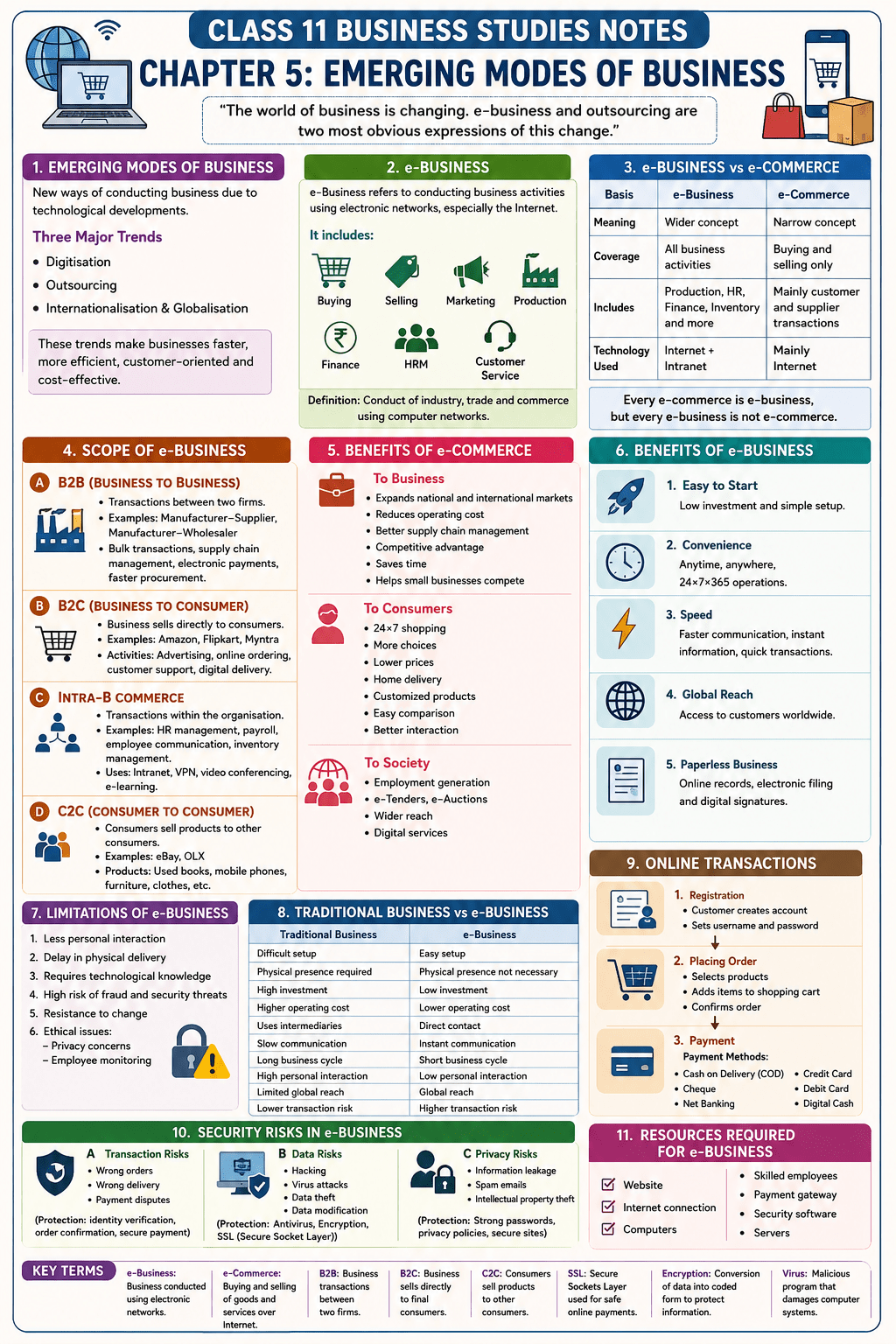
Class 11 Business Studies Notes
Chapter 5: Emerging Modes of Business

Chapter Overview
Learning Objectives
After studying this chapter, you should be able to:
- Define e-business and e-commerce
- Explain online buying and selling
- Differentiate traditional business and e-business
- Explain the benefits and limitations of e-business
- Understand online payment systems
- Identify security risks in e-business
- Understand Business Process Outsourcing (BPO) and its importance.
1. Emerging Modes of Business
Meaning
Emerging modes of business are new ways of conducting business made possible due to technological developments.
Three Major Trends
- Digitisation
- Outsourcing
- Internationalisation & Globalisation
These trends help businesses become:
- Faster
- More efficient
- Customer-oriented
- Cost-effective.
2. e-Business
Meaning
e-Business refers to conducting business activities using electronic networks, especially the Internet.
It includes:
- Buying
- Selling
- Marketing
- Production
- Finance
- Human Resource Management
- Customer Service
Definition
Conduct of industry, trade and commerce using computer networks.
3. e-Business vs e-Commerce
| e-Business | e-Commerce |
|---|---|
| Wider concept | Narrow concept |
| Covers all business activities | Covers buying and selling only |
| Includes production, HR, finance, inventory | Mainly customer and supplier transactions |
| Uses Internet + Intranet | Mainly Internet |
Remember
Every e-commerce is e-business, but every e-business is not e-commerce.
4. Scope of e-Business
(A) B2B (Business to Business)
Business transactions between two firms.
Examples
- Manufacturer and supplier
- Manufacturer and wholesaler
Features
- Bulk transactions
- Supply chain management
- Electronic payments
- Faster procurement
(B) B2C (Business to Consumer)
Business sells directly to consumers.
Examples
- Amazon
- Flipkart
- Myntra
Activities include:
- Advertising
- Online ordering
- Customer support
- Digital delivery
(C) Intra-B Commerce
Transactions within the organisation.
Examples:
- HR management
- Payroll
- Employee communication
- Inventory management
Uses:
- Intranet
- VPN
- Video conferencing
- E-learning
(D) C2C (Consumer to Consumer)
Consumers sell products to other consumers.
Examples:
- eBay
- OLX
Products sold:
- Used books
- Furniture
- Mobile phones
- Clothes
5. Benefits of e-Commerce
Benefits to Business
- Expands national and international markets
- Reduces operating cost
- Better supply chain management
- Competitive advantage
- Saves time
- Helps small businesses compete
Benefits to Consumers
- 24×7 shopping
- More choices
- Lower prices
- Home delivery
- Customized products
- Easy comparison
- Better interaction
Benefits to Society
- Employment generation
- e-Tenders
- e-Auctions
- Wider reach
- Digital services
6. Benefits of e-Business
1. Easy to Start
- Low investment
- Simple setup
2. Convenience
- Anytime
- Anywhere
- 24×7×365 operations
3. Speed
- Faster communication
- Instant information
- Quick transactions
4. Global Reach
- Worldwide market access
5. Paperless Business
- Online records
- Electronic filing
- Digital signatures
7. Limitations of e-Business
- Less personal interaction
- Delay in physical delivery
- Requires technological knowledge
- High risk of fraud
- Resistance to change
- Ethical issues
- Privacy concerns
- Employee monitoring
8. Traditional Business vs e-Business
| Traditional Business | e-Business |
|---|---|
| Difficult setup | Easy setup |
| Physical presence required | Physical presence not necessary |
| High investment | Low investment |
| Higher operating cost | Lower operating cost |
| Uses intermediaries | Direct contact |
| Slow communication | Instant communication |
| Long business cycle | Short business cycle |
| High personal interaction | Low personal interaction |
| Limited global reach | Global reach |
| Lower transaction risk | Higher transaction risk |
9. Online Transactions
Step 1: Registration
Customer:
- Creates account
- Sets username and password
Step 2: Placing Order
Customer:
- Selects products
- Adds items to shopping cart
- Confirms order
Step 3: Payment
Payment methods:
- Cash on Delivery (COD)
- Cheque
- Net Banking
- Credit Card
- Debit Card
- Digital Cash
10. Security Risks in e-Business
(A) Transaction Risks
- Wrong orders
- Wrong delivery
- Payment disputes
(B) Data Risks
- Hacking
- Virus attacks
- Data theft
- Data modification
Protection:
- Antivirus software
- Encryption
- SSL (Secure Socket Layer)
(C) Privacy Risks
- Information leakage
- Spam emails
- Intellectual property theft
11. Resources Required for e-Business
Businesses need:
- Website
- Internet connection
- Computers
- Skilled employees
- Payment gateway
- Security software
- Servers
Important Terms
Digitisation
Conversion of information into digital form.
e-Business
Business through electronic networks.
e-Commerce
Buying and selling using the Internet.
B2B
Business to Business.
B2C
Business to Consumer.
C2C
Consumer to Consumer.
Intra-B Commerce
Transactions within an organisation.
Shopping Cart
Virtual basket for selected items.
SSL (Secure Socket Layer)
Provides secure online payment.
Encryption
Converting data into coded form.
Virus
Malicious program that damages computer systems.
Important CBSE Points
✔ e-Business is broader than e-Commerce.
✔ B2B involves business firms only.
✔ B2C deals directly with consumers.
✔ C2C involves consumers selling to consumers.
✔ Online shopping follows three stages:
- Registration
- Placing Order
- Payment
✔ Major benefits:
- Speed
- Convenience
- Global reach
- Lower cost
✔ Major limitations:
- Security risks
- Lack of personal touch
- Technology requirement
CBSE Exam Questions
Very Short Answer (1 Mark)
- Define e-business.
- What is B2B?
- What is C2C?
- What is SSL?
- Define digital cash.
Short Answer (3 Marks)
- Differentiate e-business and e-commerce.
- Explain benefits of e-business.
- Explain online payment methods.
- Discuss security risks.
Long Answer (6 Marks)
- Explain the scope of e-business.
- Compare traditional business and e-business.
- Explain limitations of e-business.
- Describe the process of online shopping.
Quick Revision Mind Map
Emerging Modes of Business
- Digitisation
- Outsourcing
- Globalisation
↓
e-Business
- B2B
- B2C
- C2C
- Intra-B
↓
Benefits
- Easy setup
- Speed
- Convenience
- Global reach
- Paperless
↓
Limitations
- Low personal touch
- Security issues
- Delivery delays
- Privacy concerns
↓
Online Shopping
- Registration
- Order
- Payment
↓
Security
- Virus
- Hacking
- Encryption
- SSL
These notes cover the key concepts, definitions, comparisons, benefits, limitations, and exam-oriented points from NCERT Class 11 Business Studies Chapter 5: Emerging Modes of Business, making them suitable for quick revision and CBSE board preparation.
 Accounting and Commerce Notes
Leave a comment