
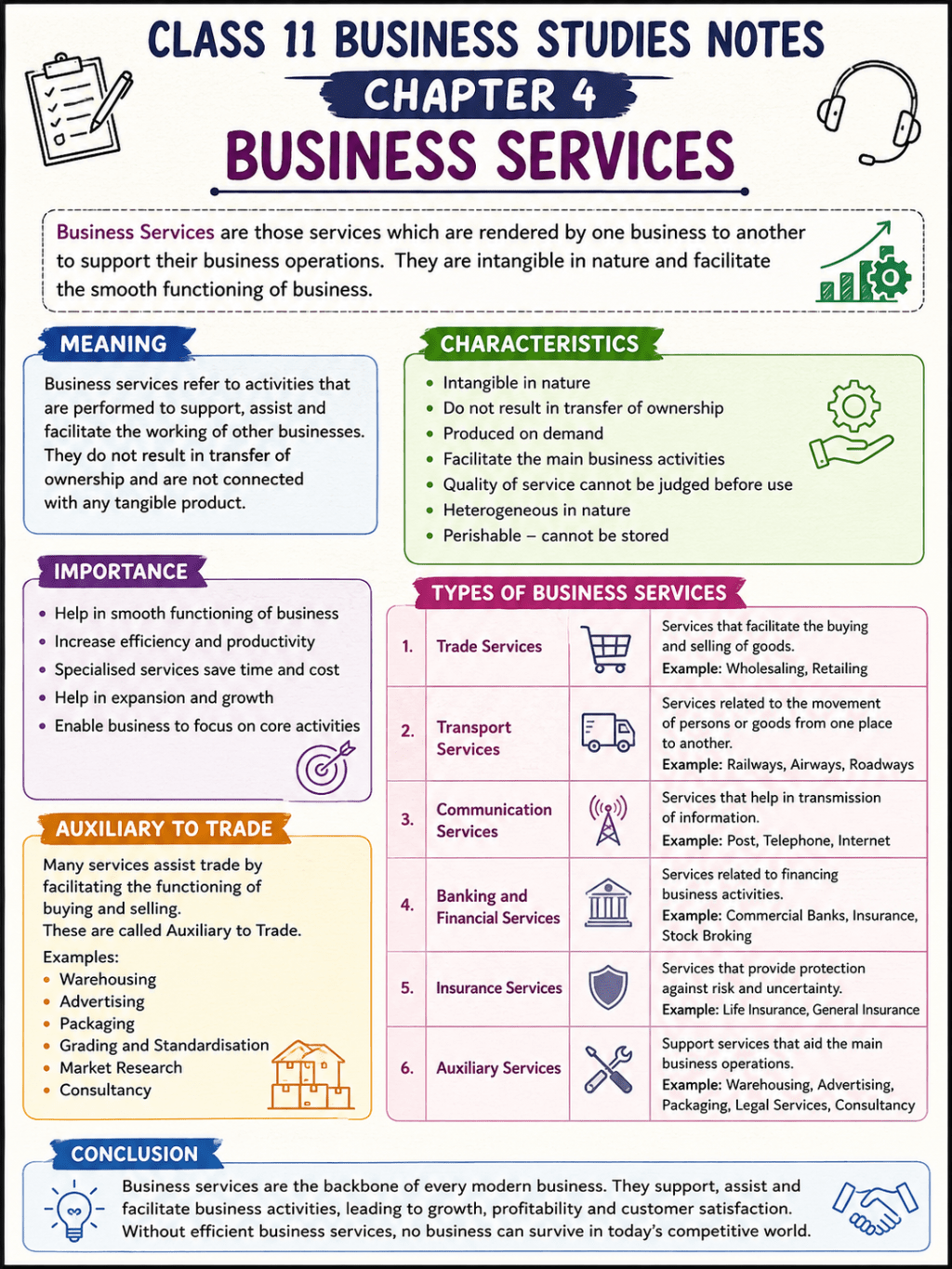
Class 11 Business Studies Notes
Chapter 4: Business Services (CBSE)

Chapter at a Glance
Business services are services that help businesses perform their operations efficiently. They include banking, insurance, transportation, communication, and warehousing.
1. Business Services
Meaning
Business services are intangible activities that facilitate business operations and satisfy customer needs without transferring ownership of a physical product.
Examples
- Banking
- Insurance
- Transportation
- Warehousing
- Communication
2. Nature (Characteristics) of Services (Five I’s)
1. Intangibility
- Cannot be touched or seen.
- Can only be experienced.
- Example: Medical treatment.
2. Inconsistency
- Services vary from customer to customer.
- No complete standardization.
3. Inseparability
- Production and consumption happen simultaneously.
- Example: Haircut, teaching.
4. Inventory (Perishability)
- Services cannot be stored.
- Unused services are lost forever.
5. Involvement
- Customer participates in the service process.
- Example: Banking, education.
3. Difference Between Goods and Services
| Goods | Services |
|---|---|
| Tangible | Intangible |
| Ownership transferred | No ownership transferred |
| Can be stored | Cannot be stored |
| Produced first, consumed later | Produced and consumed together |
| Standardized | Vary according to customers |
4. Types of Services
A. Business Services
Services used by business firms.
Examples:
- Banking
- Insurance
- Warehousing
- Communication
- Transport
B. Social Services
Provided to improve welfare.
Examples:
- Education
- Healthcare
- NGO services
C. Personal Services
Designed according to customer preferences.
Examples:
- Restaurants
- Tourism
- Beauty parlours
5. Banking
Meaning
A bank accepts deposits from the public and lends money while providing various financial services.
Types of Banks
1. Commercial Banks
Accept deposits and provide loans.
Examples:
- SBI
- PNB
- HDFC Bank
- ICICI Bank
2. Cooperative Banks
Provide low-cost credit mainly to farmers and members.
3. Specialised Banks
Serve specific sectors.
Examples:
- EXIM Bank
- Development Banks
4. Central Bank
Controls the entire banking system.
India’s Central Bank: Reserve Bank of India (RBI)
6. Functions of Commercial Banks
Primary Functions
Acceptance of Deposits
- Savings Account
- Current Account
- Fixed Deposit
Lending Money
- Loans
- Overdrafts
- Cash Credit
- Discounting Bills
Other Functions
- Cheque facility
- Remittance of funds
- Locker facility
- Bill payments
- Purchase and sale of securities
7. e-Banking (Internet Banking)
Meaning
Electronic banking allows customers to perform banking transactions online using computers or mobile devices.
Services
- ATM
- Credit Cards
- Debit Cards
- NEFT
- RTGS
- Electronic Fund Transfer (EFT)
- Point of Sale (PoS)
Benefits to Customers
- 24×7 banking
- Saves time
- Banking from anywhere
- Digital payments
- Better financial records
- Safer than carrying cash
Benefits to Banks
- Lower operating cost
- Reduced branch workload
- Larger customer reach
- Competitive advantage
8. Insurance
Meaning
Insurance is an agreement where the insurer compensates the insured against financial loss in return for a premium.
Key Terms
- Insurer
- Insured
- Premium
- Policy
9. Functions of Insurance
- Provides certainty
- Offers financial protection
- Shares risk
- Helps capital formation
10. Principles of Insurance
1. Utmost Good Faith
Both parties must disclose all material facts.
2. Insurable Interest
The insured must have financial interest in the subject matter.
3. Indemnity
Compensation equals actual loss (except life insurance).
4. Proximate Cause
Nearest cause determines liability.
5. Subrogation
After paying the claim, insurer acquires rights over damaged property.
6. Contribution
If multiple insurers exist, each contributes proportionately.
7. Mitigation
The insured should minimize losses.
11. Types of Insurance
A. Life Insurance
Provides protection against uncertainty of human life.
Types
- Whole Life Policy
- Endowment Policy
- Joint Life Policy
- Annuity Policy
- Children’s Endowment Policy
B. Fire Insurance
Covers loss caused by accidental fire.
Characteristics:
- Contract of indemnity
- One-year policy (generally)
- Actual loss is compensated
C. Marine Insurance
Protects against sea-related risks.
Types:
- Hull Insurance
- Cargo Insurance
- Freight Insurance
12. Difference Between Life, Fire and Marine Insurance
| Basis | Life | Fire | Marine |
|---|---|---|---|
| Subject Matter | Human Life | Property | Ship/Cargo/Freight |
| Indemnity | No | Yes | Yes |
| Duration | Long-term | Usually 1 year | Voyage/Specified period |
| Investment Element | Yes | No | No |
| Risk | Certain | Uncertain | Uncertain |
13. Communication Services
Importance
Facilitates exchange of information between businesses and stakeholders.
Postal Services
Financial Services
- Savings schemes
- Money Orders
- Time Deposits
- PPF
Mail Services
- Speed Post
- Registered Post
- Parcel
- Insurance
Other Services
- Greeting Post
- Media Post
- Direct Post
- Passport Services
- International Money Transfer
- e-Bill Post
Telecom Services
- Cellular Mobile Services
- Fixed Line Services
- Cable Services
- VSAT Services
- DTH Services
14. Transportation
Meaning
Transportation moves goods and passengers from one place to another.
Importance
- Removes place barrier
- Supports trade
- Quick delivery
- National economic growth
Modes:
- Road
- Rail
- Air
- Water
15. Warehousing
Meaning
Warehousing means scientific storage of goods until they are needed.
Types of Warehouses
Private Warehouses
Owned by private companies.
Public Warehouses
Open to the public for storage.
Bonded Warehouses
Store imported goods before customs duty is paid.
Government Warehouses
Owned by government organizations.
Cooperative Warehouses
Owned by cooperative societies.
16. Functions of Warehousing
- Consolidation
- Break Bulk
- Stock Piling
- Value Addition
- Price Stabilisation
- Financing
Important Definitions (Exam Ready)
Business Services: Services that assist business operations and satisfy customer needs without transferring ownership.
Bank: A financial institution accepting deposits and providing loans.
Insurance: A contract to compensate financial losses arising from uncertain events.
e-Banking: Banking services conducted through electronic media and the internet.
Warehousing: Scientific storage of goods for future use.
Most Important CBSE Exam Questions
Very Short Answer (1 Mark)
- Define business services.
- What is e-banking?
- What is insurable interest?
- What is warehousing?
Short Answer (3 Marks)
- Explain the five characteristics of services.
- State functions of commercial banks.
- Explain principles of insurance.
- Differentiate between goods and services.
Long Answer (5 Marks)
- Explain different types of insurance.
- Explain types and functions of warehouses.
- Explain the importance of communication services.
- Describe banking services and functions of commercial banks.
Quick Revision (One Page)
- Five I’s: Intangibility, Inconsistency, Inseparability, Inventory-less, Involvement
- Types of Services: Business, Social, Personal
- Types of Banks: Commercial, Cooperative, Specialised, Central
- Functions of Banks: Deposits, Loans, Cheques, Remittance, Allied Services
- Insurance Principles: Good Faith, Insurable Interest, Indemnity, Proximate Cause, Subrogation, Contribution, Mitigation
- Types of Insurance: Life, Fire, Marine
- Postal Services: Financial + Mail Services
- Telecom Services: Mobile, Fixed Line, Cable, VSAT, DTH
- Types of Warehouses: Private, Public, Bonded, Government, Cooperative
- Functions of Warehousing: Consolidation, Break Bulk, Stock Piling, Value Addition, Price Stabilisation, Financing
These notes are concise, exam-oriented, and aligned with the CBSE 2026–27 NCERT syllabus for Class 11 Business Studies Chapter 4: Business Services.
 Accounting and Commerce Notes
Leave a comment