
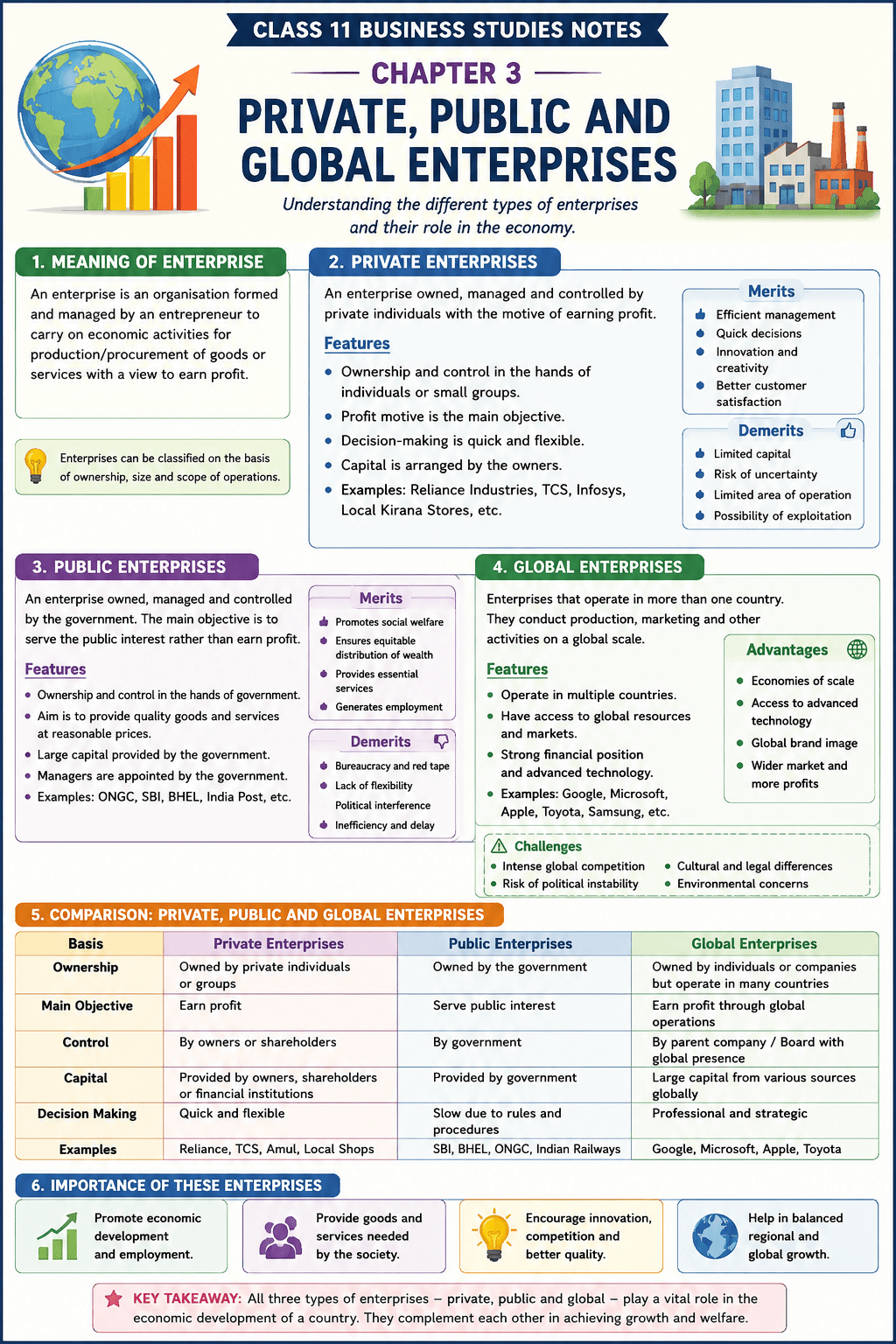
Class 11 Business Studies Notes
Chapter 3: Private, Public and Global Enterprises (CBSE)

Chapter Overview
This chapter explains:
- Private Sector and Public Sector
- Forms of Public Sector Enterprises
- Changing Role of Public Sector
- Global Enterprises (MNCs)
- Joint Ventures
- Public Private Partnership (PPP)
1. Private Sector and Public Sector
Private Sector
The private sector consists of businesses owned and managed by individuals or groups of individuals.
Forms
- Sole Proprietorship
- Partnership
- Joint Hindu Family Business
- Cooperative Society
- Company
Objective
- Earn profit
- Customer satisfaction
- Business expansion
Public Sector
The public sector consists of enterprises owned and managed by the Government.
Ownership may be:
- Central Government
- State Government
- Joint ownership of Central and State Governments
Objectives
- Public welfare
- Balanced regional development
- Employment generation
- Infrastructure development
- National security
Mixed Economy
India follows a Mixed Economy, where both:
- Private Sector
- Public Sector
operate together.
2. Forms of Public Sector Enterprises
There are three forms:
- Departmental Undertaking
- Statutory Corporation
- Government Company
A. Departmental Undertaking
Meaning
A departmental undertaking is directly controlled by a Government ministry.
Examples
- Indian Railways
- India Post
Features
- Owned by Government
- Managed by Government departments
- Employees are Government servants
- Financed through Government budget
- Revenue goes to Government treasury
- Subject to Government accounting and audit
Merits
- High public accountability
- Parliamentary control
- Suitable for national security
- Government earns all revenue
Limitations
- Lack of flexibility
- Red-tapism
- Political interference
- Slow decision-making
- Poor customer service
B. Statutory Corporation
Meaning
A statutory corporation is created through a Special Act of Parliament.
Examples include organizations established by specific legislation.
Features
- Created by Parliament
- Separate legal entity
- Can sue and be sued
- Financial autonomy
- Own employees
- Independent management
Merits
- Operational flexibility
- Financial independence
- Government support
- Helps economic development
Limitations
- Political interference
- Corruption
- Government control in major decisions
- Delay in approvals
C. Government Company
Meaning
A Government Company is registered under the Companies Act, 2013.
Government must hold at least 51% of the paid-up share capital.
Features
- Separate legal entity
- Managed like a company
- Can own property
- Can enter contracts
- Raises funds from Government and public
- Employees are not Government servants
Merits
- Easy to establish
- Better management flexibility
- Professional administration
- Market competition
Limitations
- Government interference
- Less Parliamentary control
- Companies Act has limited relevance where Government is sole shareholder
Comparison of Public Sector Enterprises
| Basis | Departmental Undertaking | Statutory Corporation | Government Company |
|---|---|---|---|
| Formation | Ministry | Special Act | Companies Act, 2013 |
| Legal Status | No separate entity | Separate entity | Separate entity |
| Ownership | Government | Government | Government (51%+) |
| Employees | Government servants | Own employees | Own employees |
| Flexibility | Very Low | Moderate | High |
3. Changing Role of Public Sector
Initially, the Public Sector was established to promote economic development.
Major Roles
1. Development of Infrastructure
Examples:
- Railways
- Power
- Petroleum
- Steel
- Airways
2. Regional Balance
Industries are established in backward areas to:
- Reduce regional inequalities
- Increase employment
3. Economies of Scale
Government sets up industries requiring:
- Huge investment
- Large-scale production
Examples:
- Steel
- Petroleum
- Electricity
4. Prevent Concentration of Wealth
Public sector prevents monopolies by reducing concentration of economic power.
5. Import Substitution
Produces goods domestically to reduce imports.
Examples:
- Heavy machinery
- Engineering goods
4. Industrial Policy 1991
The New Industrial Policy introduced four major reforms:
1. Revive profitable PSUs
Improve efficiency of potentially viable Public Sector Undertakings.
2. Close loss-making PSUs
Close enterprises that cannot be revived.
3. Reduce Government ownership
Government equity reduced in non-strategic enterprises.
4. Protect workers
Provide compensation, retraining and voluntary retirement schemes.
Major Changes
A. Reduction in Reserved Industries
Earlier:
- 17 industries
Then:
- 8 industries
Now:
- 3 industries
Reserved industries:
- Atomic Energy
- Arms and Defence
- Rail Transport
B. Disinvestment
Meaning:
Sale of Government shares in PSUs.
Objectives:
- Raise funds
- Improve efficiency
- Increase public participation
C. Sick Units
Loss-making PSUs were referred for:
- Restructuring
- Closure
D. Memorandum of Understanding (MoU)
Agreement between:
- Government
- PSU Management
Purpose:
- More autonomy
- Better accountability
- Performance targets
5. Global Enterprises (MNCs)
Meaning
Global Enterprises or Multinational Corporations (MNCs) operate in more than one country.
Examples include large international companies with worldwide operations.
Features
1. Huge Capital Resources
Can raise funds from:
- Banks
- Investors
- International markets
2. Foreign Collaboration
Collaborate with Indian companies through:
- Technology transfer
- Licensing
- Brand sharing
3. Advanced Technology
Use:
- Modern machinery
- High-quality production
- Latest technology
4. Product Innovation
Continuous research and development.
5. Strong Marketing
- Global brands
- Massive advertising
- Effective promotion
6. Worldwide Market
Operate through:
- Subsidiaries
- Branches
- Affiliates
7. Centralised Control
Head office controls worldwide operations while allowing local day-to-day management.
6. Joint Venture
Meaning
A Joint Venture is an agreement between two or more businesses to work together for a common objective.
Resources, risks and profits are shared.
Types of Joint Venture
1. Contractual Joint Venture (CJV)
- No separate business entity
- Agreement only
Example:
- Franchise arrangement
2. Equity Joint Venture (EJV)
- Separate jointly owned business created
- Shared ownership
- Shared management
- Shared profits
Benefits of Joint Ventures
- Increased resources
- Better capacity
- Access to new markets
- Access to technology
- Product innovation
- Lower production cost
- Established brand name
7. Public Private Partnership (PPP)
Meaning
PPP is a partnership between Government and Private Sector for infrastructure and public service projects.
Features
- Shared investment
- Shared risks
- Better efficiency
- Public ownership with private expertise
Strengths
- Faster project completion
- Better technology
- Efficient management
Weaknesses
- Possible conflicts
- Limited private finance in some projects
Example
- Kundli–Manesar Expressway
Important Definitions (Exam-Oriented)
Private Sector: Businesses owned by individuals or groups.
Public Sector: Enterprises owned and managed by Government.
Departmental Undertaking: Government department carrying out business activities.
Statutory Corporation: Corporation created through an Act of Parliament.
Government Company: Company in which Government owns at least 51% of paid-up capital.
Disinvestment: Sale of Government shares in Public Sector Enterprises.
Global Enterprise: Company operating in many countries.
Joint Venture: Two or more businesses working together for a common objective.
Public Private Partnership (PPP): Partnership between Government and private sector for infrastructure and public services.
Quick Revision Table
| Topic | Key Point |
|---|---|
| Mixed Economy | Public + Private Sector |
| Forms of Public Enterprises | Departmental, Statutory, Government Company |
| Government Company | Government owns ≥51% shares |
| Departmental Undertaking | Direct ministry control |
| Statutory Corporation | Created by Act of Parliament |
| Industrial Policy 1991 | Liberalisation, Privatisation, Globalisation |
| Disinvestment | Sale of Government shares |
| MNC | Operates in many countries |
| Joint Venture | Shared ownership/resources |
| PPP | Government + Private partnership |
Important Exam Questions
Very Short Answer (1 Mark)
- Define Public Sector.
- What is Disinvestment?
- What is a Government Company?
- Define Joint Venture.
- What is PPP?
Short Answer (3 Marks)
- Explain the features of Departmental Undertakings.
- State the merits of Statutory Corporations.
- Explain Government Companies.
- Features of Global Enterprises.
Long Answer (6 Marks)
- Explain the changing role of the Public Sector.
- Discuss the Industrial Policy of 1991.
- Explain the benefits of Joint Ventures.
- Compare the three forms of Public Sector Enterprises.
These notes cover all major NCERT concepts in Chapter 3 and are suitable for CBSE Class 11 Commerce revision.
 Accounting and Commerce Notes
Leave a comment