
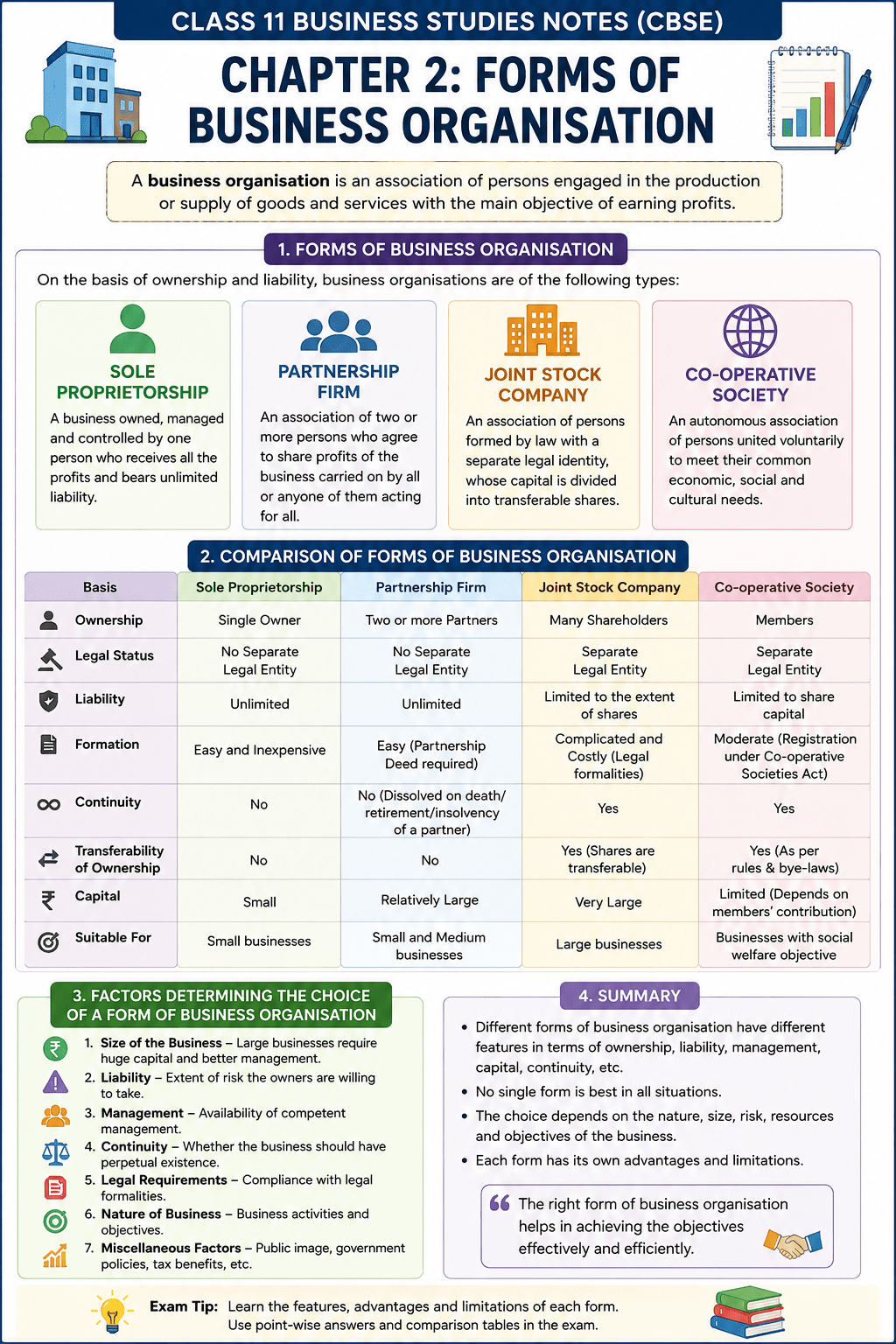
Class 11 Business Studies Notes
Chapter 2: Forms of Business Organisation (CBSE)

Chapter Overview
A business organisation is the legal structure under which a business operates. The choice of organisation affects ownership, liability, control, capital, continuity, and profit distribution.
Learning Objectives
- Understand different forms of business organisation.
- Explain their features, merits and limitations.
- Compare different forms.
- Identify factors affecting the choice of organisation.
Forms of Business Organisation
- Sole Proprietorship
- Joint Hindu Family Business (HUF)
- Partnership
- Cooperative Society
- Joint Stock Company
1. Sole Proprietorship
Meaning
A business owned, managed and controlled by one person, who receives all profits and bears all risks.
Definition
A sole proprietor is the only owner of the business.
Features
- Single owner
- Easy formation and closure
- Unlimited liability
- Sole risk bearer
- Sole profit recipient
- Complete control
- No separate legal entity
- Lack of business continuity
Merits
- Quick decision making
- Business secrecy
- Direct incentive
- Personal satisfaction
- Easy to start and close
Limitations
- Limited capital
- Limited managerial ability
- Unlimited liability
- Limited life of business
Suitable For
- Grocery shops
- Medical stores
- Beauty parlours
- Tailoring shops
- Small retail businesses
2. Joint Hindu Family Business (HUF)
Meaning
A business owned by members of a Hindu Undivided Family (HUF) and governed by Hindu Law.
The head of the family is called the Karta.
Features
- Membership by birth
- Minimum two members
- Governed by Hindu Succession Act
- Karta has control
- Karta has unlimited liability
- Other members have limited liability
- Business enjoys continuity
- Minors can become members
Merits
- Effective control
- Stable business
- Limited liability of members
- Loyalty among family members
Limitations
- Limited resources
- Unlimited liability of Karta
- Dominance of Karta
- Limited managerial skills
3. Partnership
Meaning
A business owned by two or more persons who agree to share profits and losses.
Governed by
Indian Partnership Act, 1932
Features
- Formed by agreement
- Minimum 2 partners
- Maximum 50 partners (present rule)
- Unlimited liability
- Mutual agency
- Shared risks
- Joint management
- Lack of continuity
Merits
- Easy formation
- Balanced decisions
- More capital
- Sharing of risks
- Business secrecy
Limitations
- Unlimited liability
- Limited resources
- Possibility of conflicts
- Lack of continuity
- Low public confidence
Types of Partners
Active Partner
- Invests capital
- Participates in management
- Shares profits
- Unlimited liability
Sleeping Partner
- Invests capital
- No management
- Shares profits
- Unlimited liability
Secret Partner
- Identity hidden
- Participates in management
- Unlimited liability
Nominal Partner
- Lends name only
- No capital
- No management
- Unlimited liability
Partner by Estoppel
Acts like a partner and becomes liable.
Partner by Holding Out
Allows others to represent him as partner and becomes liable.
Types of Partnership
Based on Duration
Partnership at Will
Continues until partners decide otherwise.
Particular Partnership
Created for a specific project or period.
Based on Liability
General Partnership
Unlimited liability.
Limited Partnership
Some partners have limited liability.
Partnership Deed
A written agreement containing:
- Name of firm
- Nature of business
- Capital contribution
- Profit-sharing ratio
- Duties of partners
- Interest on capital
- Admission and retirement rules
- Dissolution procedure
- Settlement of disputes
Registration of Partnership
Registration is optional but advisable.
Advantages
A registered firm can:
- Sue outsiders
- Partners can sue each other
- Enjoy legal recognition
4. Cooperative Society
Meaning
A voluntary association formed to protect the economic interests of members through cooperation.
Governed by
- State Cooperative Societies Act
- Multi-State Cooperative Societies Act, 2002
Features
- Voluntary membership
- Separate legal entity
- Limited liability
- Democratic control
- Service motive
Merits
- Equality in voting
- Limited liability
- Stable existence
- Economy in operations
- Government support
- Easy formation
Limitations
- Limited resources
- Poor management
- Lack of secrecy
- Government control
- Internal conflicts
Types of Cooperative Societies
- Consumer Cooperative Society
- Producer Cooperative Society
- Marketing Cooperative Society
- Farmer Cooperative Society
- Credit Cooperative Society
- Cooperative Housing Society
5. Joint Stock Company
Meaning
A company is an artificial legal person formed under the Companies Act, 2013.
Ownership lies with shareholders.
Management lies with the Board of Directors.
Features
- Artificial person
- Separate legal entity
- Perpetual succession
- Limited liability
- Common seal (traditional concept)
- Transferability of shares
- Professional management
Merits
- Limited liability
- Easy transfer of shares
- Perpetual existence
- Large capital
- Professional management
Limitations
- Difficult formation
- Lack of secrecy
- Complex legal formalities
- Delay in decision making
- Numerous regulations
- Conflict of interests
- Oligarchic management
Types of Companies
Private Company
- Minimum members: 2
- Maximum members: 200
- Restricts transfer of shares
- Cannot invite public to subscribe
- Minimum directors: 2
Public Company
- Minimum members: 7
- No maximum limit
- Free transfer of shares
- Can invite public
- Minimum directors: 3
Difference Between Private and Public Company
| Basis | Private Company | Public Company |
|---|---|---|
| Minimum Members | 2 | 7 |
| Maximum Members | 200 | Unlimited |
| Share Transfer | Restricted | Free |
| Public Invitation | Not Allowed | Allowed |
| Minimum Directors | 2 | 3 |
Factors Affecting Choice of Business Organisation
- Cost of formation
- Ease of formation
- Liability
- Continuity
- Capital requirements
- Managerial ability
- Degree of control
- Nature of business
Comparative Summary
| Form | Owners | Liability | Continuity | Control |
|---|---|---|---|---|
| Sole Proprietorship | One | Unlimited | Low | Owner |
| Partnership | 2–50 | Unlimited | Moderate | Partners |
| HUF | Family Members | Karta Unlimited | High | Karta |
| Cooperative Society | Members | Limited | High | Managing Committee |
| Company | Shareholders | Limited | Very High | Board of Directors |
Important Definitions (Exam)
- Sole Proprietorship: Business owned and managed by one person.
- Partnership: Agreement between two or more persons to share profits.
- Joint Hindu Family Business: Business run by members of a Hindu Undivided Family.
- Cooperative Society: Voluntary association formed for mutual benefit.
- Company: Artificial legal person with separate legal entity and perpetual succession.
Important CBSE Exam Points
- Learn features, merits and limitations of every form.
- Memorize types of partners.
- Learn types of cooperative societies.
- Understand the difference between Private and Public Company.
- Practice comparison tables for 3–5 mark questions.
- Revise the factors affecting the choice of business organisation, a frequently tested topic.
 Accounting and Commerce Notes
Leave a comment