Class 12 Accountancy I Notes
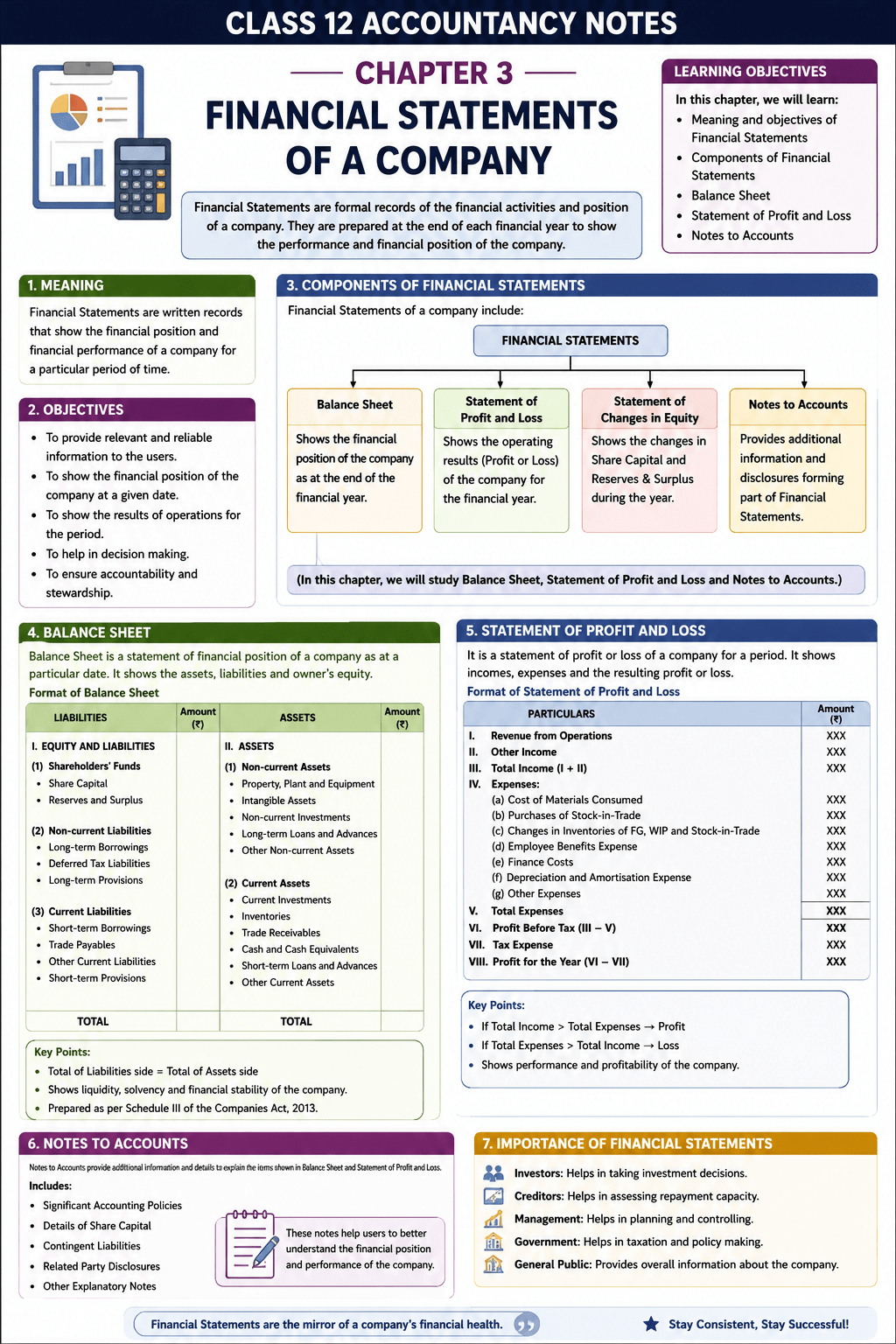
Chapter 3: Financial Statements of a Company

1. Financial Statements – Meaning
Financial Statements are the formal annual reports prepared by a company to communicate its financial performance and financial position to shareholders, investors, creditors, government and other users.
They mainly include:
- Balance Sheet
- Statement of Profit and Loss
- Cash Flow Statement
Purpose: To help users make economic and financial decisions.
2. Nature of Financial Statements
Financial statements are based on four important elements:
(i) Recorded Facts
- Prepared from accounting records.
- Based on historical cost.
- Do not show current market values.
(ii) Accounting Conventions
Prepared according to conventions such as:
- Conservatism
- Materiality
- Cost concept
(iii) Accounting Postulates
Prepared on assumptions like:
- Going Concern
- Money Measurement
- Realisation Concept
(iv) Personal Judgements
Used while estimating:
- Depreciation
- Bad debts
- Inventory valuation
- Provisions
Remember: Financial statements = Recorded Facts + Accounting Principles + Personal Judgements.
3. Objectives of Financial Statements
Main Objective
To provide useful information for decision-making.
Specific Objectives
- Provide information about assets and liabilities.
- Show earning capacity.
- Provide cash flow information.
- Judge management efficiency.
- Show company’s impact on society.
- Disclose accounting policies.
4. Types of Financial Statements
There are three major financial statements:
1. Balance Sheet
Shows:
- Financial Position
- Assets
- Liabilities
- Shareholders’ Equity
Prepared on a particular date.
2. Statement of Profit and Loss
Shows:
- Revenue
- Expenses
- Profit or Loss
Prepared for an accounting period.
3. Cash Flow Statement
Shows:
- Cash Inflows
- Cash Outflows
- Net Increase/Decrease in Cash
Prepared according to AS-3.
5. Format of Balance Sheet (Schedule III)
I. Equity and Liabilities
A. Shareholders’ Funds
- Share Capital
- Reserves & Surplus
- Money received against Share Warrants
B. Share Application Money Pending Allotment
C. Non-Current Liabilities
- Long-term Borrowings
- Deferred Tax Liabilities
- Other Long-term Liabilities
- Long-term Provisions
D. Current Liabilities
- Short-term Borrowings
- Trade Payables
- Other Current Liabilities
- Short-term Provisions
II. Assets
A. Non-Current Assets
- Tangible Assets
- Intangible Assets
- Capital Work-in-Progress
- Investments
- Deferred Tax Assets
- Long-term Loans
- Other Non-current Assets
B. Current Assets
- Current Investments
- Inventories
- Trade Receivables
- Cash & Cash Equivalents
- Short-term Loans
- Other Current Assets
6. Important Features of Schedule III
- Applicable to all companies.
- Vertical format is compulsory.
- Current & Non-current classification is mandatory.
- Trade Debtors → Trade Receivables.
- Sundry Creditors → Trade Payables.
- Notes to Accounts are compulsory.
- Accounting Standards override Schedule III.
7. Shareholders’ Funds
Includes:
(i) Share Capital
Disclosures include:
- Authorised Capital
- Issued Capital
- Subscribed Capital
- Paid-up Capital
- Calls in Arrears
- Rights attached to shares
- Shares held by holding company
- Shareholders holding more than 5%
- Bonus shares
- Buy-back details
(ii) Reserves and Surplus
Includes:
- Capital Reserve
- Capital Redemption Reserve
- Securities Premium
- Debenture Redemption Reserve
- Revaluation Reserve
- Share Option Outstanding Account
- Other Reserves
- Surplus (Profit & Loss Balance)
Important
- Debit balance of Profit & Loss is shown as a negative figure.
- Reserve represented by investments is called Fund.
(iii) Money Received Against Share Warrants
Amount received before conversion into equity shares.
Shown separately under Shareholders’ Funds.
8. Current and Non-current Classification
Current Asset
An asset is current if:
- Expected to be realised within 12 months
- Part of operating cycle
- Held for trading
- Cash or Cash Equivalent
Otherwise → Non-current Asset.
Current Liability
A liability is current if:
- Payable within 12 months
- Related to operating cycle
- Company has no unconditional right to defer payment
Otherwise → Non-current Liability.
9. Important Classifications
Inventories
Always Current Asset
Fixed Assets
Always Non-current
Trade Receivables
Current or Non-current depending on realisation period.
Trade Payables
Current or Non-current depending on settlement period.
Investments
Can be Current or Non-current.
Deferred Tax
Always Non-current.
Proposed Dividend
Shown in Notes to Accounts as a contingent item until approved by shareholders.
10. Format of Statement of Profit and Loss
Income
- Revenue from Operations
- Other Income
Total Revenue
Expenses
- Cost of Materials Consumed
- Purchase of Stock-in-Trade
- Change in Inventory
- Employee Benefit Expenses
- Finance Cost
- Depreciation & Amortisation
- Other Expenses
Profit Before Tax (PBT)
Formula
Profit Before Tax = Total Revenue − Total Expenses
11. Revenue from Operations
Includes:
- Sale of Goods
- Sale of Services
- Other Operating Income
12. Other Income
Includes:
- Interest Income
- Dividend Income
- Profit on Sale of Investments
- Other Non-operating Income
13. Major Expenses
Cost of Materials Consumed
Raw materials used.
Purchase of Stock-in-Trade
Goods purchased for resale.
Employee Benefit Expenses
- Salaries
- Wages
- Bonus
- Staff Welfare
Finance Cost
Interest on loans.
Depreciation
Reduction in value of fixed assets.
Other Expenses
Administrative and selling expenses.
14. Uses and Importance of Financial Statements
Financial Statements help:
- Shareholders
- Investors
- Creditors
- Government
- Banks
- Employees
- Stock Exchanges
- Trade Associations
They are useful for:
- Performance evaluation
- Granting loans
- Investment decisions
- Taxation
- Corporate governance
- Decision making
15. Limitations of Financial Statements
- Based on historical cost.
- May not reflect current market value.
- Based on estimates and judgement.
- Show only aggregate information.
- Ignore qualitative factors.
- Some important information is omitted.
- Represent financial position only for a specific date.
Quick Revision (Exam Ready)
Financial Statements
- Balance Sheet
- Statement of Profit & Loss
- Cash Flow Statement
Shareholders’ Funds
- Share Capital
- Reserves & Surplus
- Share Warrants
Non-current Liabilities
- Debentures
- Long-term Loans
- Deferred Tax
Current Liabilities
- Trade Payables
- Short-term Borrowings
- Provisions
Current Assets
- Inventory
- Trade Receivables
- Cash
- Short-term Loans
Non-current Assets
- Fixed Assets
- Investments
- Intangible Assets
- Capital WIP
Statement of Profit & Loss
Revenue → Expenses → Profit Before Tax → Tax → Profit After Tax
Important Exam Points
- Schedule III format is compulsory for companies.
- Balance Sheet shows the financial position on a particular date.
- Statement of Profit & Loss shows profitability for an accounting period.
- Trade Debtors are now called Trade Receivables.
- Sundry Creditors are now called Trade Payables.
- Inventories are always Current Assets.
- Deferred Tax Assets/Liabilities are always Non-current.
- Profit Before Tax = Total Revenue − Total Expenses.
 Accounting and Commerce Notes
Leave a comment