
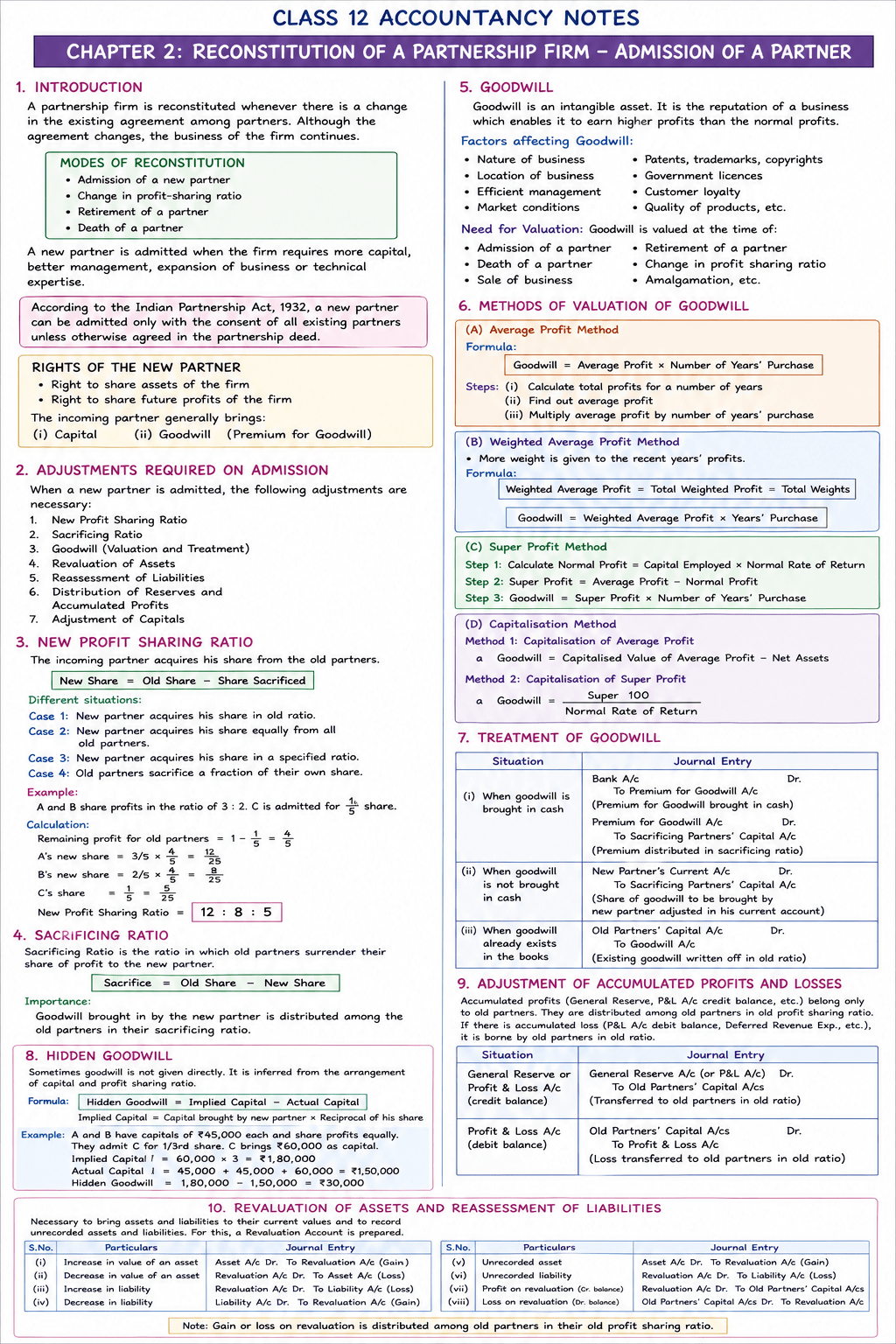
Class 12 Accountancy I Notes
Chapter 2: Reconstitution of a Partnership Firm – Admission of a Partner

Chapter Overview
A partnership firm is reconstituted whenever there is a change in the existing agreement among partners. Although the agreement changes, the business continues.
Modes of Reconstitution
- Admission of a new partner
- Change in profit-sharing ratio
- Retirement of a partner
- Death of a partner
1. Admission of a Partner
A new partner is admitted when the firm requires:
- Additional capital
- Better management
- Business expansion
- Technical expertise
According to the Indian Partnership Act, 1932, a new partner can be admitted only with the consent of all existing partners unless otherwise agreed in the partnership deed.
Rights of the New Partner
- Right to share assets
- Right to share future profits
The incoming partner generally brings:
- Capital
- Goodwill (Premium for Goodwill)
2. Adjustments Required on Admission
Whenever a partner is admitted, the following accounting adjustments are required:
- New Profit Sharing Ratio
- Sacrificing Ratio
- Goodwill
- Revaluation of Assets
- Reassessment of Liabilities
- Distribution of Reserves and Accumulated Profits
- Adjustment of Capitals
3. New Profit Sharing Ratio
The incoming partner acquires his share from the old partners.
Formula
New Share = Old Share − Share Sacrificed
Different situations:
Case 1
New partner acquires share in old ratio.
Case 2
Share acquired equally.
Case 3
Share acquired in a specified ratio.
Case 4
Old partners sacrifice a fraction of their own share.
Example
A and B share profits 3:2.
C admitted for 1/5 share.
Remaining profit = 4/5
New Ratio
A = 3/5 × 4/5 = 12/25
B = 2/5 × 4/5 = 8/25
C = 5/25
New Ratio
12 : 8 : 5
4. Sacrificing Ratio
Sacrificing Ratio is the ratio in which old partners surrender their profit to the new partner.
Formula
Sacrifice = Old Share − New Share
Importance
Goodwill is distributed among old partners in the sacrificing ratio.
5. Goodwill
Meaning
Goodwill is an intangible asset representing the reputation of a business that enables it to earn higher-than-normal profits.
Factors Affecting Goodwill
- Nature of business
- Location
- Efficient management
- Market conditions
- Patents and trademarks
- Government licences
- Customer loyalty
Need for Valuation
Goodwill is valued during:
- Admission
- Retirement
- Death
- Change in Profit Sharing Ratio
- Sale of Business
- Amalgamation
6. Methods of Valuation of Goodwill
(A) Average Profit Method
Formula
Goodwill
= Average Profit × Number of Years Purchase
Steps
Calculate total profits.
Find average profit.
Multiply by years’ purchase.
(B) Weighted Average Profit Method
Recent years receive higher weights.
Formula
Weighted Average Profit
= Total Weighted Profit ÷ Total Weights
Goodwill
= Weighted Average Profit × Years Purchase
(C) Super Profit Method
Step 1
Normal Profit
= Capital × Normal Rate of Return
Step 2
Super Profit
= Average Profit − Normal Profit
Step 3
Goodwill
= Super Profit × Years Purchase
(D) Capitalisation Method
Method 1
Capitalisation of Average Profit
Goodwill
= Capitalised Value − Net Assets
Method 2
Capitalisation of Super Profit
Goodwill
= Super Profit × 100 ÷ Normal Rate of Return
7. Treatment of Goodwill
When Goodwill is brought in cash
Entry
Bank A/c Dr.
To Premium for Goodwill A/c
Premium for Goodwill A/c Dr.
To Sacrificing Partners’ Capital A/c
When Goodwill is not brought
New Partner’s Current A/c Dr.
To Sacrificing Partners’ Capital A/c
When Goodwill already exists
Old Partners’ Capital A/c Dr.
To Goodwill A/c
8. Hidden Goodwill
Sometimes goodwill is not given directly.
It is calculated from the capital brought by the new partner.
Formula
Hidden Goodwill
= Implied Capital − Actual Capital
Implied Capital
= Capital Brought × Reciprocal of Share
9. Accumulated Profits and Losses
These belong only to old partners.
Examples
- General Reserve
- Profit & Loss Account
- Workmen Compensation Reserve
- Investment Fluctuation Reserve
Journal Entries
General Reserve
General Reserve A/c Dr.
To Old Partners’ Capital A/c
Debit Balance of P&L
Old Partners’ Capital A/c Dr.
To Profit & Loss A/c
10. Revaluation of Assets and Liabilities
Purpose
To bring assets and liabilities to their current values before admitting a new partner.
Revaluation Entries
Increase in Asset
Asset A/c Dr.
To Revaluation A/c
Decrease in Asset
Revaluation A/c Dr.
To Asset A/c
Increase in Liability
Revaluation A/c Dr.
To Liability A/c
Decrease in Liability
Liability A/c Dr.
To Revaluation A/c
Unrecorded Asset
Asset A/c Dr.
To Revaluation A/c
Unrecorded Liability
Revaluation A/c Dr.
To Liability A/c
Profit on Revaluation
Revaluation A/c Dr.
To Old Partners’ Capital A/c
Loss on Revaluation
Old Partners’ Capital A/c Dr.
To Revaluation A/c
Important Formulas
New Ratio
Old Share − Sacrifice
Sacrifice
Old Share − New Share
Average Profit
Total Profit ÷ Number of Years
Weighted Average Profit
Weighted Profit ÷ Total Weights
Normal Profit
Capital × Normal Rate ÷ 100
Super Profit
Average Profit − Normal Profit
Goodwill (Average Profit)
Average Profit × Years Purchase
Goodwill (Super Profit)
Super Profit × Years Purchase
Goodwill (Capitalisation)
Super Profit × 100 ÷ Normal Rate
Hidden Goodwill
Implied Capital − Actual Capital
Important Journal Entries for Exams
- Admission of partner
- Premium for goodwill
- Goodwill adjustment
- Goodwill written off
- Hidden goodwill
- Revaluation
- Distribution of reserves
- Adjustment of accumulated losses
- Capital adjustment
CBSE Exam Tips
- Learn all goodwill formulas thoroughly.
- Practice new ratio and sacrificing ratio calculations.
- Memorize journal entries for goodwill and revaluation.
- Solve numerical questions on hidden goodwill.
- Draw Revaluation and Partners’ Capital Accounts neatly with proper narration.
- Most board exam questions combine goodwill, revaluation, reserves, and capital adjustment in a single comprehensive problem.
 Accounting and Commerce Notes
Leave a comment