
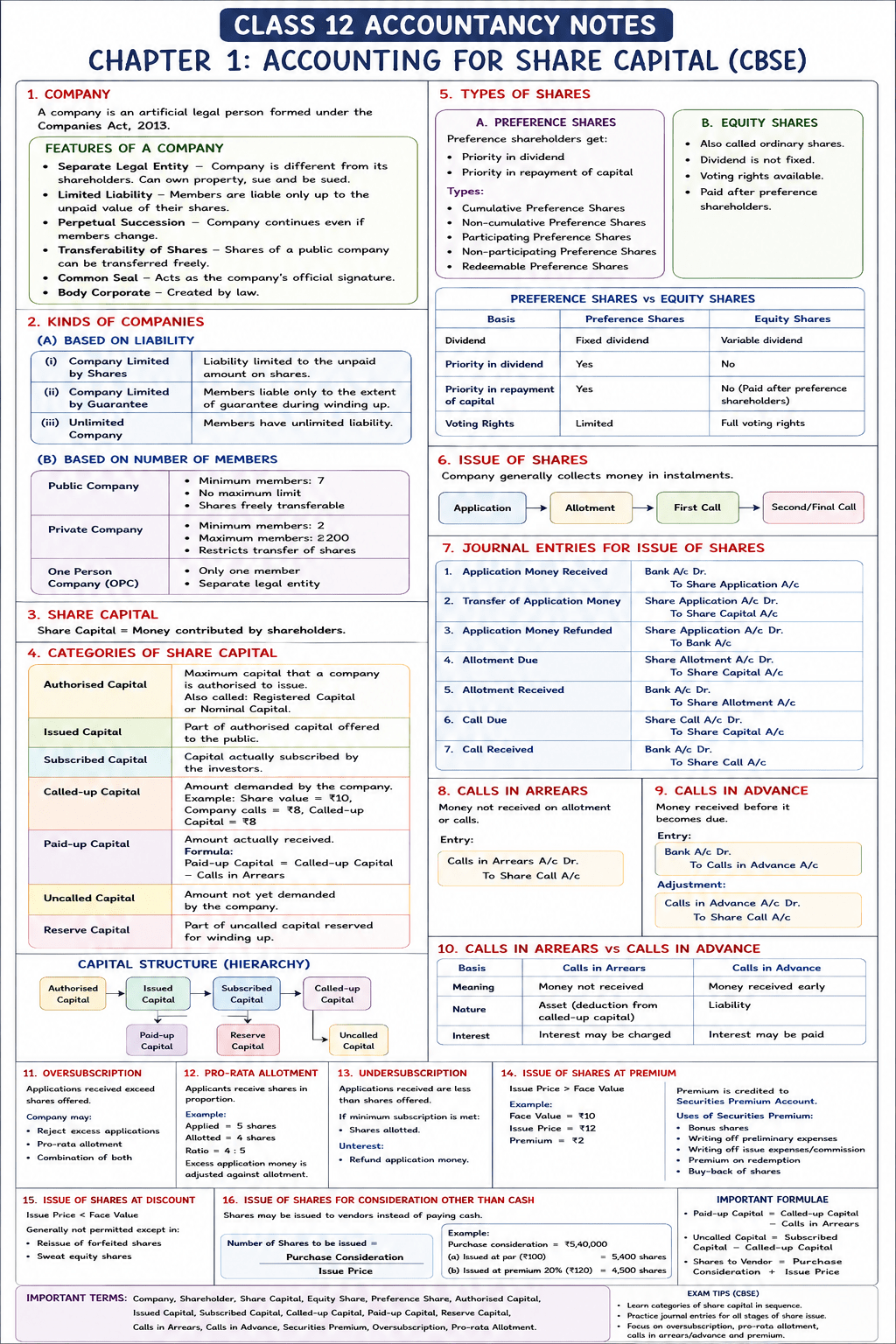
Class 12 Accountancy II Notes – Chapter 1: Accounting for Share Capital (CBSE)

Chapter Overview
This chapter explains:
- Meaning and features of a company
- Types of companies
- Share capital and its categories
- Types of shares
- Issue of shares
- Calls in arrears and calls in advance
- Oversubscription & undersubscription
- Issue of shares at premium
- Issue of shares for consideration other than cash
1. Company
A company is an artificial legal person formed under the Companies Act, 2013.
Definition
A company is an incorporated association having:
- Separate legal existence
- Perpetual succession
- Limited liability
- Common seal
2. Features of a Company
1. Separate Legal Entity
- Company is different from its shareholders.
- Can own property.
- Can sue and be sued.
2. Limited Liability
Members are liable only up to unpaid value of their shares.
3. Perpetual Succession
Company continues even if members change.
4. Transferability of Shares
Public company shares can be transferred freely.
5. Common Seal
Acts as the company’s official signature.
6. Body Corporate
Created by law.
3. Kinds of Companies
A. Based on Liability
(i) Company Limited by Shares
Liability limited to unpaid share amount.
(ii) Company Limited by Guarantee
Members pay only guaranteed amount during winding up.
(iii) Unlimited Company
Members have unlimited liability.
B. Based on Number of Members
Public Company
- Minimum members: 7
- No maximum limit
- Shares freely transferable
Private Company
- Minimum members: 2
- Maximum members: 200
- Restricts transfer of shares
One Person Company (OPC)
- Only one member
- Separate legal entity
4. Share Capital
Share Capital = Money contributed by shareholders.
5. Categories of Share Capital
1. Authorised Capital
Maximum capital company can issue.
Also called:
- Registered Capital
- Nominal Capital
2. Issued Capital
Part of authorised capital offered to public.
3. Subscribed Capital
Capital actually subscribed by investors.
4. Called-up Capital
Amount demanded by company.
Example
Share Value = ₹10
Company calls = ₹8
Called-up Capital = ₹8
5. Paid-up Capital
Amount actually received.
Formula
Paid-up Capital = Called-up Capital − Calls in Arrears
6. Uncalled Capital
Amount not yet demanded.
7. Reserve Capital
Part of uncalled capital reserved for winding up.
Capital Structure Diagram
Authorised Capital│├── Issued Capital│├── Subscribed Capital│├── Called-up Capital│├── Paid-up Capital│└── Reserve Capital
6. Types of Shares
A. Preference Shares
Preference shareholders get:
✔ Priority in dividend
✔ Priority in repayment of capital
Types
- Cumulative
- Non-cumulative
- Participating
- Non-participating
- Redeemable
B. Equity Shares
- Ordinary shares
- Dividend is not fixed.
- Voting rights available.
- Paid after preference shareholders.
Preference vs Equity Shares
| Preference Shares | Equity Shares |
|---|---|
| Fixed dividend | Variable dividend |
| Priority in dividend | No priority |
| Priority in capital repayment | Paid after preference shares |
| Limited voting rights | Full voting rights |
7. Issue of Shares
Company generally collects money in instalments.
Stages
- Application
- Allotment
- First Call
- Second/Final Call
Share Issue Procedure
Prospectus ↓Applications ↓Allotment ↓Calls
8. Minimum Subscription
Minimum subscription must generally be 90% of the issue before allotment can proceed (as per the provisions discussed in the chapter).
If minimum subscription is not received:
- Shares cannot be allotted.
- Application money is refunded.
9. Journal Entries for Issue of Shares
A. Application Money Received
Bank A/c Dr. To Share Application A/c
B. Transfer of Application Money
Share Application A/c Dr. To Share Capital A/c
C. Application Money Refunded
Share Application A/c Dr. To Bank A/c
D. Allotment Due
Share Allotment A/c Dr. To Share Capital A/c
E. Allotment Received
Bank A/c Dr. To Share Allotment A/c
F. Call Due
Share Call A/c Dr. To Share Capital A/c
G. Call Received
Bank A/c Dr. To Share Call A/c
10. Calls in Arrears
Money not received on allotment or calls.
Entry
Calls in Arrears A/c Dr. To Share Call A/c
11. Calls in Advance
Money received before it becomes due.
Entry
Bank A/c Dr. To Calls in Advance A/c
Adjustment:
Calls in Advance A/c Dr. To Share Call A/c
Difference: Calls in Arrears vs Calls in Advance
| Calls in Arrears | Calls in Advance |
|---|---|
| Money not received | Money received early |
| Asset (deduction from called-up capital) | Liability |
| Interest may be charged | Interest may be paid |
12. Oversubscription
Applications received exceed shares offered.
Company may:
- Reject excess applications
- Pro-rata allotment
- Combination of both
Pro-rata Allotment
Applicants receive shares in proportion.
Example:
Applied = 5 shares
Allotted = 4 shares
Ratio = 4 : 5
Excess application money is adjusted against allotment.
13. Undersubscription
Applications received are less than shares offered.
If minimum subscription is met:
- Shares allotted.
Otherwise:
- Refund application money.
14. Issue of Shares at Premium
Issue Price > Face Value
Example
Face Value = ₹10
Issue Price = ₹12
Premium = ₹2
Premium is credited to:
Securities Premium Account
Uses of Securities Premium
- Bonus shares
- Writing off preliminary expenses
- Writing off issue expenses/commission
- Premium on redemption
- Buy-back of shares
Journal Entry (Premium on Allotment)
Share Allotment A/c Dr. To Share Capital A/c To Securities Premium A/c
15. Issue of Shares at Discount
Generally not permitted except in cases such as:
- Reissue of forfeited shares
- Sweat equity shares
16. Issue of Shares for Consideration Other Than Cash
Shares may be issued to vendors instead of paying cash.
Important Formulae
Paid-up Capital
Paid-up Capital = Called-up Capital − Calls in Arrears
Uncalled Capital
Uncalled Capital = Subscribed Capital − Called-up Capital
Shares Issued to Vendor
Purchase Consideration ÷ Issue Price
Important Terms
- Company
- Shareholder
- Share Capital
- Equity Share
- Preference Share
- Authorised Capital
- Issued Capital
- Subscribed Capital
- Called-up Capital
- Paid-up Capital
- Reserve Capital
- Calls in Arrears
- Calls in Advance
- Securities Premium
- Oversubscription
- Pro-rata Allotment
Exam Tips (CBSE)
- Learn all categories of share capital in sequence.
- Practice journal entries for application, allotment, and calls.
- Memorize the treatment of Calls in Arrears, Calls in Advance, and Securities Premium.
- Be comfortable solving oversubscription and pro-rata allotment problems.
- Practice numerical questions on journal entries regularly.
 Accounting and Commerce Notes
Leave a comment