
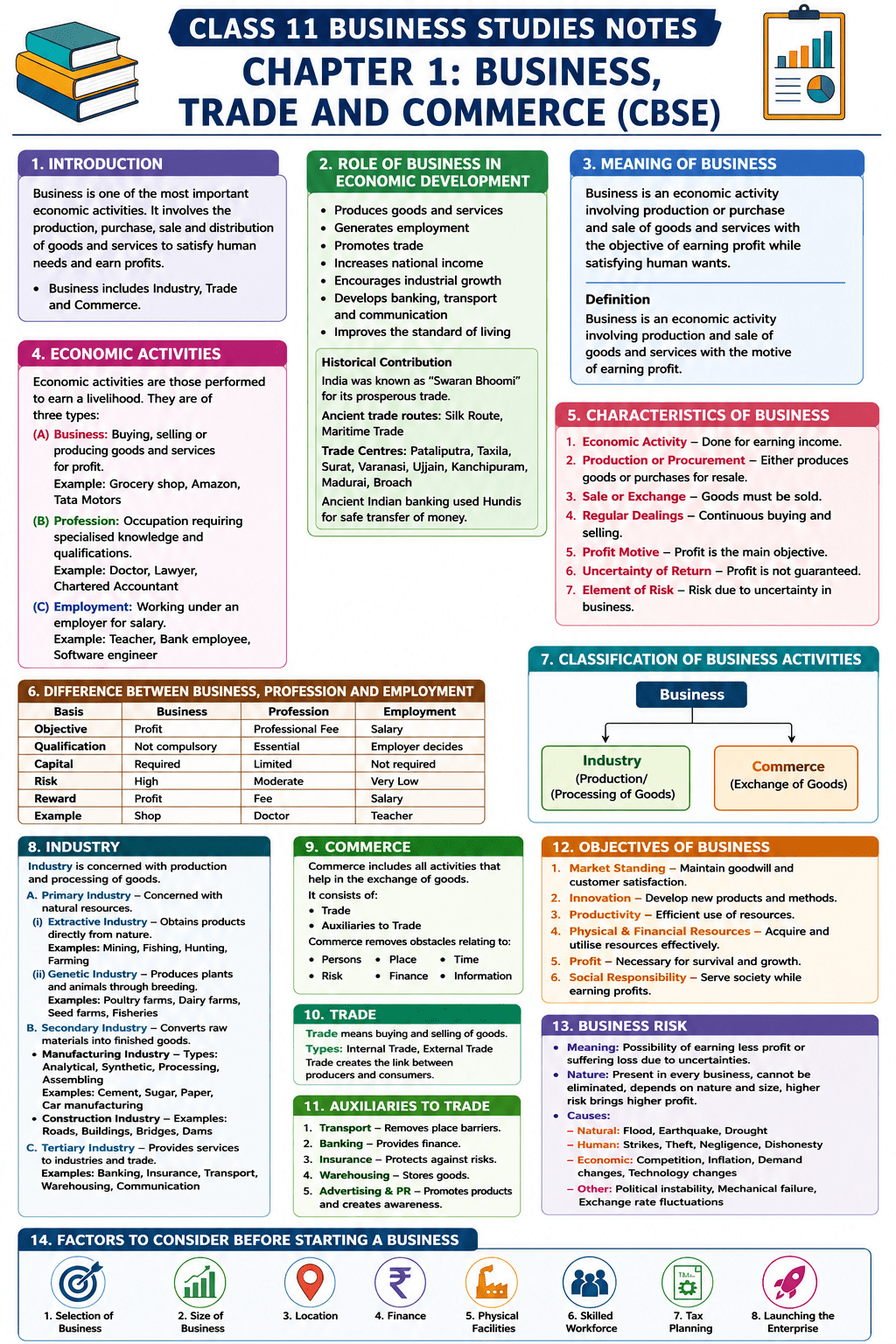
Class 11 Business Studies Notes
Chapter 1: Business, Trade and Commerce (CBSE)

1. Introduction
Business is one of the most important economic activities. It involves the production, purchase, sale, and distribution of goods and services to satisfy human needs and earn profits.
- Business begins with production and ends with consumption.
- It includes Industry, Trade, and Commerce.
2. Role of Business in Economic Development
Business contributes to the economy by:
- Producing goods and services
- Generating employment
- Promoting trade
- Increasing national income
- Encouraging industrial growth
- Developing banking, transport and communication
- Improving the standard of living
Historical Contribution
India was known as “Swaran Bhoomi” because of its prosperous trade.
Major ancient trade routes:
- Silk Route
- Maritime Trade
Important trade centres:
- Pataliputra
- Taxila
- Surat
- Varanasi
- Ujjain
- Kanchipuram
- Madurai
- Broach
Ancient Indian banking used Hundis for safe transfer of money.
3. Meaning of Business
Business is an economic activity involving the production or purchase and sale of goods and services with the objective of earning profit while satisfying human wants.
Definition
Business is an economic activity involving production and sale of goods and services with the motive of earning profit.
4. Economic Activities
Economic activities are those performed to earn a livelihood.
They are of three types:
(A) Business
Buying, selling or producing goods and services for profit.
Example:
- Grocery shop
- Amazon
- Tata Motors
(B) Profession
Occupation requiring specialised knowledge and qualifications.
Examples:
- Doctor
- Lawyer
- Chartered Accountant
(C) Employment
Working under an employer for salary.
Examples:
- Teacher
- Bank employee
- Software engineer
5. Characteristics of Business
1. Economic Activity
Done for earning income.
2. Production or Procurement
Business either:
- Produces goods, or
- Purchases goods for resale.
3. Sale or Exchange
Goods must be sold.
Production for personal use is not business.
4. Regular Dealings
Business involves continuous buying and selling.
One-time sale is not business.
5. Profit Motive
Profit is the main objective.
6. Uncertainty of Return
Profit is never guaranteed.
7. Element of Risk
Every business faces uncertainty due to:
- Competition
- Fire
- Theft
- Natural disasters
- Change in demand
6. Difference Between Business, Profession and Employment
| Basis | Business | Profession | Employment |
|---|---|---|---|
| Objective | Profit | Professional Fee | Salary |
| Qualification | Not compulsory | Essential | Employer decides |
| Capital | Required | Limited | Not required |
| Risk | High | Moderate | Very Low |
| Reward | Profit | Fee | Salary |
| Example | Shop | Doctor | Teacher |
7. Classification of Business Activities
Business is divided into:
Business│├── Industry│└── Commerce
8. Industry
Industry is concerned with production and processing of goods.
Types of Industry
A. Primary Industry
Concerned with natural resources.
(i) Extractive Industry
Obtains products directly from nature.
Examples:
- Mining
- Fishing
- Hunting
- Farming
(ii) Genetic Industry
Produces plants and animals through breeding.
Examples:
- Poultry farms
- Dairy farms
- Seed farms
- Fisheries
B. Secondary Industry
Converts raw materials into finished goods.
Manufacturing Industry
Types:
- Analytical
- Synthetic
- Processing
- Assembling
Examples:
- Cement
- Sugar
- Paper
- Car manufacturing
Construction Industry
Examples:
- Roads
- Buildings
- Bridges
- Dams
C. Tertiary Industry
Provides services to industries and trade.
Examples:
- Banking
- Insurance
- Transport
- Warehousing
- Communication
9. Commerce
Commerce includes all activities that help in the exchange of goods.
It consists of:
- Trade
- Auxiliaries to Trade
Commerce removes obstacles relating to:
- Persons
- Place
- Time
- Risk
- Finance
- Information
10. Trade
Trade means buying and selling of goods.
Types
- Internal Trade
- External Trade
Trade creates the link between producers and consumers.
11. Auxiliaries to Trade
1. Transport
Removes place barriers.
2. Banking
Provides finance.
3. Insurance
Protects against business risks.
4. Warehousing
Stores goods until required.
5. Advertising & Public Relations
Promotes products and creates awareness.
12. Objectives of Business
Business has multiple objectives.
Economic Objectives
1. Market Standing
Maintain goodwill and customer satisfaction.
2. Innovation
Develop new products and methods.
3. Productivity
Efficient use of resources.
4. Physical and Financial Resources
Acquire and utilise resources effectively.
5. Profit
Necessary for survival and growth.
6. Social Responsibility
Serve society while earning profits.
13. Business Risk
Meaning
Business risk means the possibility of earning less profit or suffering losses due to uncertainties.
Examples:
- Fire
- Theft
- Strike
- Change in customer demand
- Price fluctuations
Nature of Business Risk
- Present in every business
- Cannot be eliminated completely
- Depends upon nature and size of business
- Higher risk usually brings higher profit
Causes of Business Risk
Natural Causes
- Flood
- Earthquake
- Drought
Human Causes
- Strikes
- Theft
- Negligence
- Dishonesty
Economic Causes
- Competition
- Inflation
- Demand changes
- Technology changes
Other Causes
- Political instability
- Mechanical failure
- Exchange rate fluctuations
14. Factors to Consider Before Starting a Business
- Selection of business
- Size of business
- Location
- Finance
- Physical facilities
- Skilled workforce
- Tax planning
- Launching the enterprise
Important Definitions (Exam Ready)
Business: Economic activity involving production or sale of goods and services to earn profit.
Industry: Production and processing of goods.
Commerce: Activities facilitating exchange of goods and services.
Trade: Buying and selling of goods.
Business Risk: Possibility of inadequate profit or loss due to uncertainties.
CBSE Important Keywords
- Business
- Economic Activity
- Industry
- Commerce
- Trade
- Auxiliaries to Trade
- Business Risk
- Profit
- Innovation
- Social Responsibility
- Market Standing
- Warehousing
- Insurance
- Banking
- Transport
- Hundi
- Entrepreneurship
Important Exam Questions
Short Answer (2–3 Marks)
- Define Business.
- State any four characteristics of business.
- Differentiate between business and profession.
- What is commerce?
- Explain business risk.
- What are auxiliaries to trade?
Long Answer (5–6 Marks)
- Explain the classification of industries.
- Discuss the objectives of business.
- Explain the causes of business risk.
- Describe the factors to be considered while starting a business.
- Differentiate between Business, Profession and Employment.
These notes cover all the major concepts from CBSE Class 11 Business Studies Chapter 1: Business, Trade and Commerce in a concise, exam-oriented format.
 Accounting and Commerce Notes
Leave a comment