
Nature of Partnership
- Defined by Section 4 of the Indian Partnership Act, 1932: relation between persons agreeing to share profits of a business carried on by all or any acting for all.
- Essential features:
- Minimum 2 partners, maximum 50.
- Agreement (oral or written).
- Must carry on business (mere co-ownership ≠ partnership).
- Mutual agency: each partner is both principal and agent.
- Sharing of profits and losses.
- Unlimited liability of partners.
Partnership Deed
- Written agreement preferred, though oral is valid.
- Contains details: firm name, partners’ names, capital contribution, profit-sharing ratio, interest rules, salaries/commissions, rights/duties, dispute settlement, dissolution rules, etc.
- If deed is silent, provisions of the Partnership Act apply.
Key Provisions of Partnership Act (Relevant for Accounting)
- Profit sharing: equal if deed is silent.
- Interest on capital: not allowed unless agreed.
- Interest on drawings: not charged unless agreed.
- Interest on loan: 6% p.a. if deed is silent.
- Salary/remuneration: not allowed unless agreed.
- Partners must account for profits derived from firm’s property or competing business.
Maintenance of Capital Accounts
Two methods:
- Fixed Capital Method
- Two accounts: Capital Account (fixed balance) and Current Account (records drawings, interest, salary, commission, profit share).
- Capital account always shows credit balance.
- Current account may show debit/credit balance.
- Fluctuating Capital Method
- Single Capital Account per partner.
- All adjustments (drawings, interest, salary, commission, profit share) recorded directly.
- Balance fluctuates and may show debit or credit.
Distinction:
- Fixed → two accounts, capital balance fixed, always credit.
- Fluctuating → one account, balance changes, may be debit.
Distribution of Profit
- Profits/losses distributed in agreed ratio; if silent, equally.
- Adjustments (interest, salary, commission, drawings) made via Profit and Loss Appropriation Account.
- Starts with net profit/loss from Profit & Loss Account.
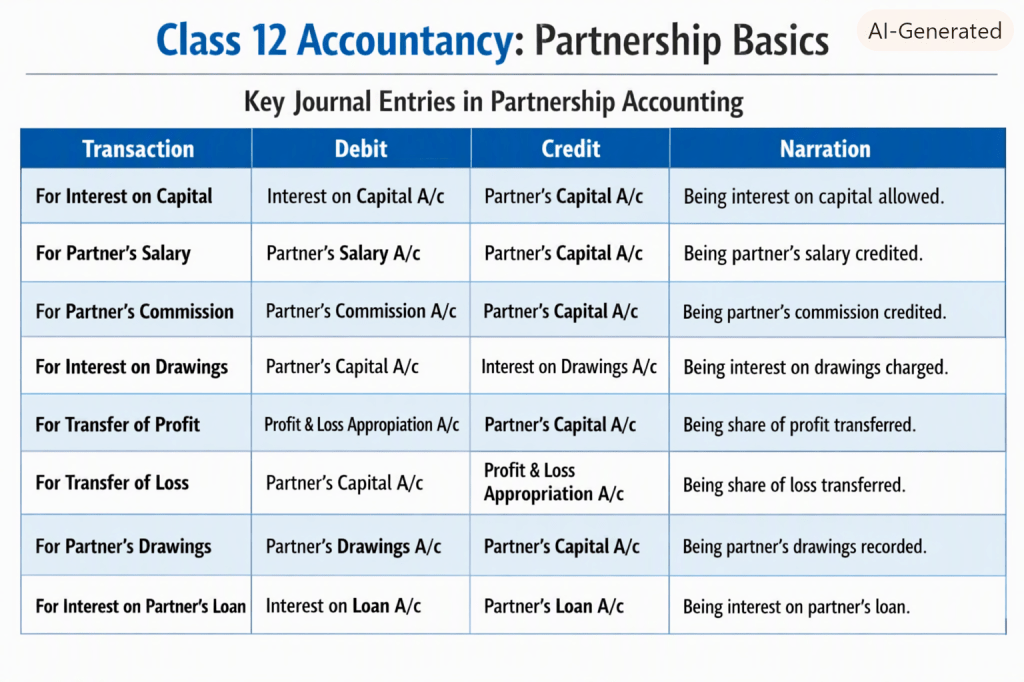
- Journal entries handle transfer of profits, interest, salary, commission, and final distribution.
Profit and Loss Appropriation Account
- Debit side: interest on capital, salary, commission, distribution of profit.
- Credit side: net profit, interest on drawings.
- Final balance distributed among partners.
Illustration (Sameer & Yasmin)
- Capitals: Rs. 15,00,000 and Rs. 10,00,000.
- Profit-sharing ratio: 3:2.
- Transactions: additional capital, interest, drawings, salary, commission, profit share.
- Demonstrates recording under both fixed and fluctuating capital methods.
 Accounting and Commerce Notes
Leave a comment